2026 · Software Engineer
APM for self-hosted Next.js
Initialize tracing before the application starts, then send server traces through a Datadog agent sidecar.
- Next.js
- Datadog
- Docker
- Azure CLI
How it fits together
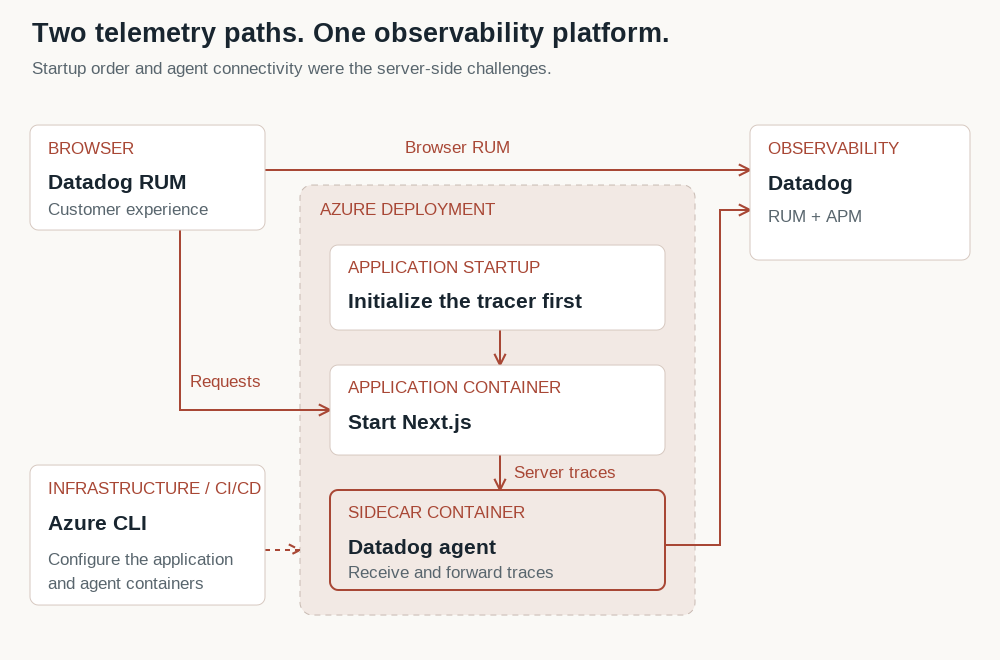
RUM in the browser. APM on the server.
Explore the architecture, then open a decision below.
-
Browser
RUM integration
Capture the customer’s browser experience.
Design reasoningRUM was the straightforward part. It does not by itself provide server-side application tracing.
-
Startup order
Tracer before Next.js
Load tracing before the application starts.
Design reasoningInitialization order matters: the tracer needs to instrument the application’s dependencies before they are loaded.
-
Server telemetry
An agent sidecar
Send traces from the application to the Datadog agent.
Design reasoningThe self-hosted application needed an agent connection. A sidecar container supplied that part of the tracing path.
-
Delivery
Deploy both containers
Configure the sidecar through Azure CLI in CI/CD.
Design reasoningIn this setup, the existing deployment path did not create the sidecar. Infrastructure and delivery changes were part of the integration.
Simplified architecture and design considerations. Internal endpoints, access policies and deployment details are omitted.
My contribution
Integrated Next.js instrumentation and the Datadog agent sidecar, including the infrastructure and CI/CD changes needed to deploy them.
Result
Browser monitoring through RUM and server-side APM through the application tracer and agent.
What made this interesting
Installing a browser SDK was only the first step. Server-side APM required the right startup order, a reachable agent, and a deployment that brought both containers together.
Technical context: Datadog tracing for Node.js.