2023 · Software Developer
Self-service API provisioning
A self-service UI backed by AWS Step Functions, GitHub provisioning and predefined Apigee proxies.
- AWS Step Functions
- GitHub
- CI/CD
- Apigee
How it fits together
Turn repeated setup into a workflow.
Explore the architecture, then open a decision below.
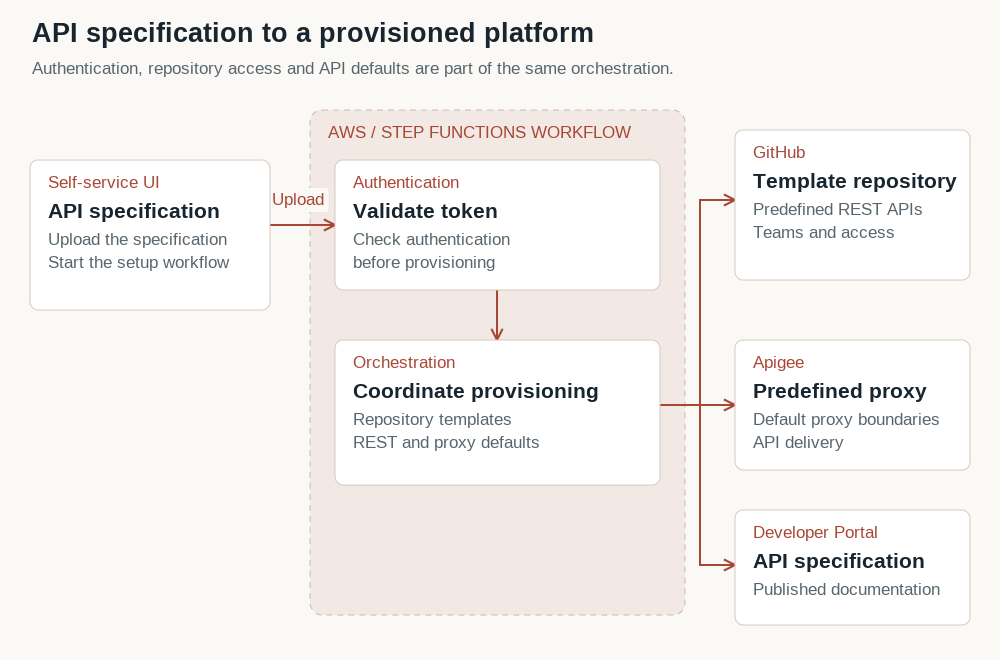
-
Developer experience
Self-service request
Upload an API specification and validate authentication.
Design reasoningProvisioning repositories and APIs changes real resources. Token validation is part of the entry boundary.
-
Orchestration
Coordinate the work
AWS Step Functions orchestrates the provisioning steps.
Design reasoningAuthentication, repository creation, access and API configuration form a workflow rather than a single API call.
-
Source and delivery
Repository and access
Create the template repository with GitHub teams and permissions.
Design reasoningCreating a repository is only part of setup. The right team access and predefined REST APIs need to be in place too.
-
API consumers
Runtime and discovery
Apply the predefined Apigee proxy and its default boundaries.
- Apigee API proxy
- Developer Portal specification
The workflow ties repository setup to consistent proxy defaults, with publishing pipelines for the proxy and specification.
Simplified architecture and design considerations. Internal endpoints, access policies and deployment details are omitted.
My contribution
Built API automation across the UI, authentication, AWS workflows, repository creation, GitHub access and teams, and predefined API/proxy setup.
Result
An uploaded API specification could start a workflow to provision a template repository and a predefined Apigee proxy.
Beyond the pipeline
I also contributed to the API catalog’s ownership, metadata and documentation, and led a KTH student team from discovery through delivery of a developer-experience project.
The diagram connects these responsibilities at a conceptual level; it does not describe Telia’s internal infrastructure.